
Sinaia cable cars & gondolas to Cota 2000
Sinaia has both a cable car and a gondola, but they leave from different stations. Find out which one you need, which sections are running and how to get back down.
First understand the two systems
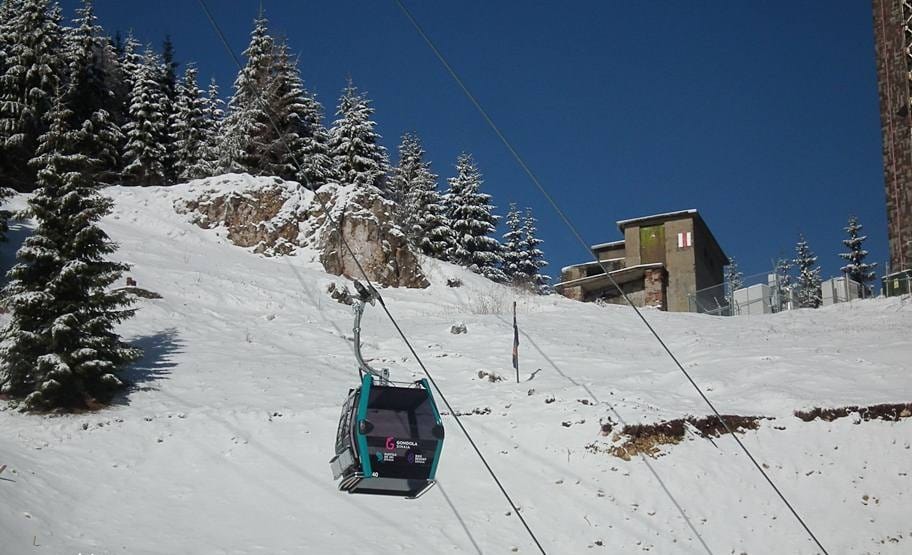
Sinaia has a cable car system (telecabină) and gondolas (telegondolă) serving the mountain above the town. Both can connect you through the Cota 1400 area towards Cota 2000, but you should not assume they share the same station or operate in the same way.
The cable car starts from its own lower terminal near town, while the Sinaia gondola has a different lower access point. The upper gondola section is called Gondola Carp. The exact route depends on which sections are operating that day.
Confusing the two stations is a common mistake: a bus ride or a taxi to the wrong terminal can cost you valuable time, particularly close to the last ascent or descent.
Which lifts are running now?
The local operator publishes operating hours and revision periods. The information checked for the 2025–26 ski season listed technical revision on the lower Gondola Sinaia section, while other lift sections had separate operating times. Do not treat a timetable or price table for that season as a live service guarantee in November 2026.
Upper lifts can stop because of wind, visibility, lightning, maintenance or safety decisions. A clear morning in Sinaia town does not prove that Cota 2000 will be accessible.
Check the operator’s current cable transport page before leaving your accommodation; ask staff on site if the online notice is unclear.
How to reach the lower terminal
Arriving by train? Sinaia station is below much of the central town, so allow for uphill streets. The municipal transport operator lists routes serving the gondola area, including links from the station via T4/T5 depending on the service pattern. This information can change with lift operation.
Use official urban transport routes to check your bus, or arrange a local taxi. A map app is useful, but search for the full station name rather than simply “Sinaia cable car”.
Driving? Check parking conditions close to your chosen terminal before setting off. Mountain lift stations can become congested on ski days and busy weekends.

What is at Cota 1400 and Cota 2000?
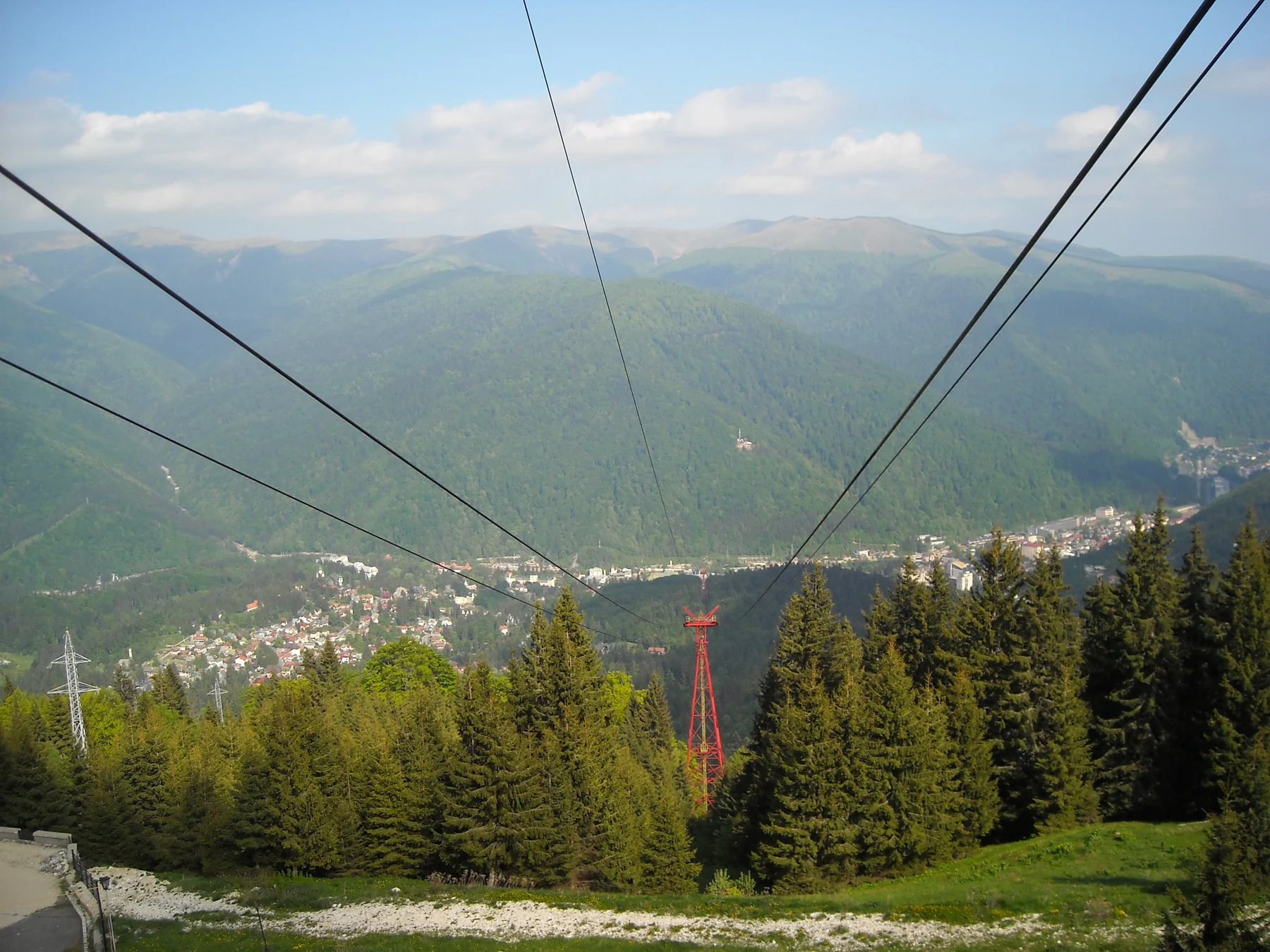
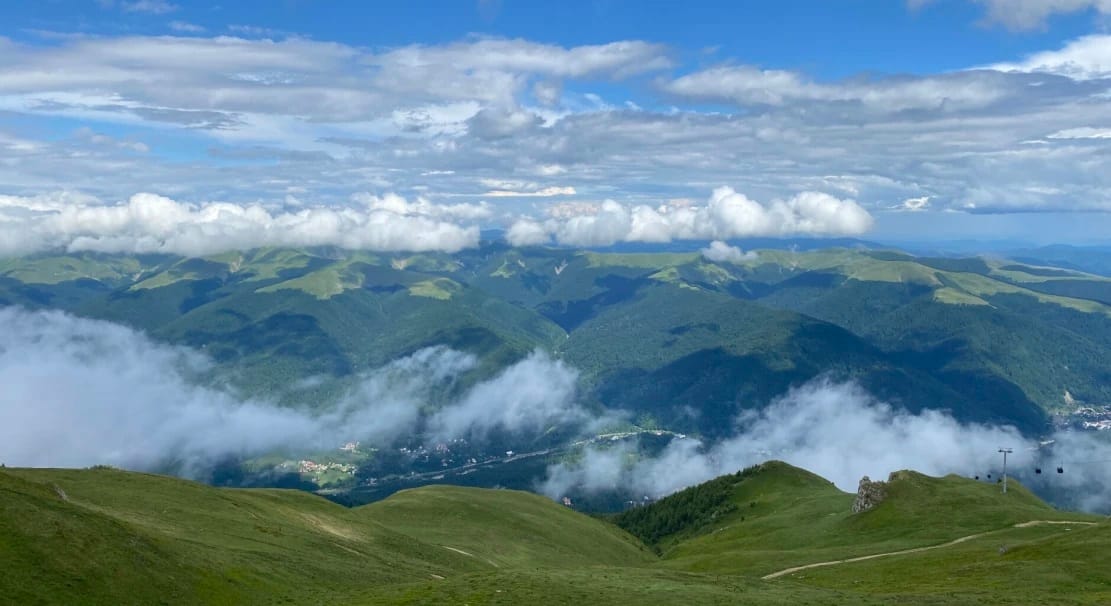
Cota 1400 is a mid-mountain area where visitors can stop, enjoy mountain scenery and connect with higher transport when it is available. Cota 2000 is a high-mountain environment: markedly more exposed, windier and cooler than the town below.
Neither altitude should be treated as an ordinary town promenade when there is snow, ice, low visibility or strong wind. Trails from the upper area are mountain routes and may be inappropriate without suitable equipment and conditions.
For a day focused on sightseeing rather than skiing, have a lower-altitude alternative ready. Consider Sinaia Monastery, the town centre or the rainy-day guide.
Tickets, equipment and practical choices
Distinguish between sightseeing access, point-based cards and ski passes. Operators can apply different products and seasonal conditions. Look for a valid return option if you are visiting as a pedestrian; do not assume that a ski-pass product is the best or only choice.
- Check whether the ticket covers one segment or the entire trip.
- Confirm the last descent before you ascend; do not plan your return around an unverified last cabin.
- Bring a windproof layer and closed, grippy footwear even when Sinaia is mild.
- Keep your mountain day flexible; delays and technical revisions are possible.
If your primary purpose is skiing, use the separate Sinaia ski area guide for pistes and equipment rather than treating this transport guide as a ski forecast.
Our recommended decision sequence
- Check mountain weather and the current lift bulletin.
- Choose the actual operating route to your intended level.
- Find that system’s correct departure station.
- Verify ticket conditions and your return journey.
- Set a cutoff time to turn back, especially on short winter days.
Visitors arriving from Bucharest for a single day should put a cable-car plan after checking train times, not before. See the rail day-trip itinerary and our Sinaia destination guide.
What the station names mean on the ground
When a Romanian sign says Telecabină, it is referring to the cable-car system, not automatically to the gondola. A telegondolă is a different type of lift, normally with smaller cabins running continuously. In Sinaia, the distinction is practical rather than linguistic: you can arrive at the wrong lower terminal simply by typing “cable car Sinaia” into a taxi app.
The lower sections connect the resort area with Cota 1400, while upper sections lead towards Cota 2000. The mountain lift operator has historically used the names Telecabina 1 and Telecabina 2 for the cable-car legs, and Gondola Sinaia and Gondola Carp for the gondolas. The two systems do not mean one continuous journey from the same boarding platform. At Cota 1400, follow current signs and staff instructions if changing between sections.
The published information for the 2025–26 season explicitly directed visitors wanting access to the Cota 1400/2000 area towards Telecabina Sinaia while the lower gondola underwent technical revision. That was a season-specific instruction, not a permanent universal route. In the following season, check again. Distinguish between a route described in an old blog, the station that physically exists and the service operating on the morning of your trip.
A realistic sightseeing day at Cota 2000
Start with a weather check before breakfast. If the forecast suggests strong wind at altitude or low cloud sitting over the mountain, resist the temptation to commit the whole day to a high viewpoint. A flexible plan for Sinaia might begin with a slow walk in town, then switch to the mountain only once the operator confirms service. If Cota 2000 is not reachable, you still have an interesting town to visit.
For a successful ascent, arrive with enough margin to understand the ticket choices and make the transfer at Cota 1400 if required. Do not use the published final departure time as the moment to begin thinking about your return. A queue, technical pause or deteriorating weather can make the last part of the day unnecessarily stressful. Leave an earlier return window and keep your phone charged with maps saved offline.
At the upper station, remember that a scenic terrace is not the same as a safe hiking route. Visitors wearing trainers suitable for a paved street should not walk into snowfields, icy slopes or poorly visible mountain terrain simply because other people are moving that way. The Cota 2000 area opens possibilities for experienced mountain walkers, but walking to distant landmarks needs route knowledge, equipment and conditions. Our Babele and Sphinx guide covers a different mountain plan.
Understanding prices without buying the wrong product
Transport Urban Sinaia’s public tariff page separates several products: season ski passes, point-based cards and lift use. These products do not necessarily represent identical access. A skier using multiple lifts throughout the day is solving a different problem from a visitor who wants a return journey to a panoramic platform. Ask for a pedestrian sightseeing option and state exactly where you wish to go before paying.
The operator labels one publicly visible table as valid for the 2025–2026 season. Treat those figures as historical context, not a price quotation for a trip later in 2026. The difference matters when calculating a family budget: four tickets plus taxis to the lower station can cost more than a casual reader expects. The safe approach is to budget a provisional amount and confirm the actual product immediately before departure.
Check the conditions attached to age categories and whether any senior or child discount requires documentation. Do not assume that an online screenshot of a lift schedule is sufficient proof of current operation. If a segment is closed, the operator’s staff can explain which alternative, if any, is available at that moment. Avoid buying a journey that you cannot complete in the time remaining.
Going up with children or people who need an easier day
Cable transport can offer remarkable mountain views without a full-day ascent on foot. That does not make the whole experience uniformly easy. There may be steps, queues, uneven surfaces and cold wind at the boarding points; a small child who is comfortable in a warm valley café may be miserable at Cota 2000 in a thin jacket. Pack a warmer layer than the town forecast suggests, plus water, snacks and shoes that grip well.
If someone in your group uses a wheelchair, a stroller or walking assistance, obtain current accessibility information for the particular lift and stations from the operator. Accessibility of the lower ticket office does not prove that every cabin, transfer level and viewing area is step-free. Ask about cabin entry, available assistance and toilets at the intended destination. A recent first-hand reply is worth much more than an unsourced claim that all lift stations are accessible.
For a trip with younger children, decide in advance whether the goal is the ride or a long activity at the top. Families sometimes enjoy a short ride and a warm drink more than a hurried race to a distant viewpoint. If the weather is unstable, stay in town. The rainy-day guide to Sinaia gives alternatives that do not depend on a mountain cabin operating.
Pairing the lifts with a Bucharest day trip
Sinaia is directly accessible by train from Bucharest, but the railway station and mountain boarding points are not one building. Allow time to leave the train, get your bearings and reach the chosen lower terminal. Local bus routes have historically served the gondola area from the railway station; the transport authority’s T4 and T5 information is a useful starting point, but check the timetable for your actual date.
Visitors often underestimate how many separate decisions fit into a “simple” one-day trip: choosing the railway departure, reaching the lift, queuing for tickets, changing altitude, arranging a meal and returning to the station. If the return train is fixed and you have only a few hours in town, do not try to combine the high-mountain ride with a full guided visit to Peleș Castle. Choose one major activity and leave time around it.
During the officially announced Peleș interior closure from 2 November to 1 December 2026, the museum is not a reliable indoor substitute for a failed cable-car plan. A town walk, an open cultural attraction or a relaxed meal is a better fallback, subject to current opening arrangements. For a complete train itinerary see Bucharest to Sinaia in a day.
Lift information and useful links
Operating hours and lift availability can change at short notice, particularly in poor weather. Check with the operator before travelling.