
Caraiman Cross, Romania: history, height and how to visit
Planning to visit Caraiman Cross above Bușteni? The World War I memorial stands at 2,291 m in Romania’s Bucegi Mountains and is listed by Guinness World Records as the “Tallest summit cross”. This guide covers its history, height, the main access options from Bușteni and Babele, and the mountain conditions to check before you go.
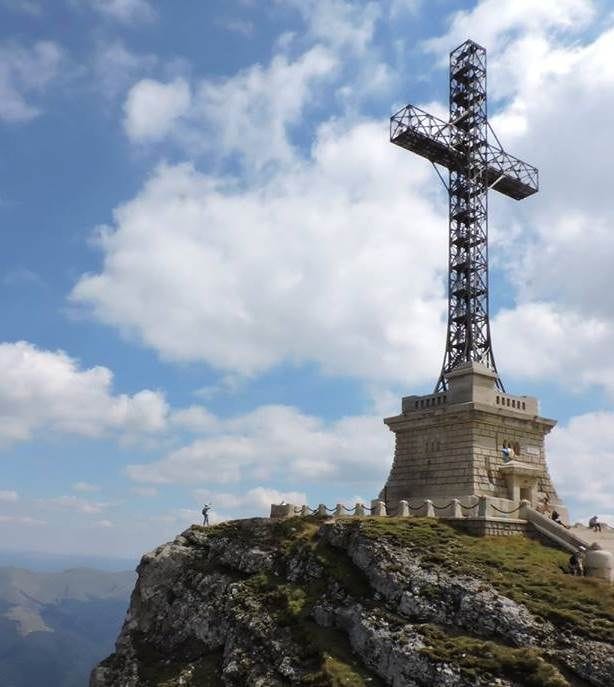
Photo: Asybaris01 / Wikimedia Commons, CC BY-SA 4.0
Caraiman Cross at a glance
The monument stands on the south-eastern side of Mount Caraiman, where it can be seen from Prahova Valley. The Ministry of National Defence says the location was deliberately chosen for visibility from below rather than on the mountain’s higher main summit.
The cross is a monument, but reaching it still means travelling through exposed high-mountain terrain. For route choice, compare the Bușteni hiking hub, the Babele area and the cable-car option before setting out.
Hiking trails from Bușteni →What is the Caraiman Cross?
Caraiman Cross is a steel summit memorial in the Bucegi Mountains, built to honour Romanian soldiers who died in World War I. The Ministry of National Defence’s English material calls it the Heroes’ Cross; locally and internationally, “Caraiman Cross” is the easier name for travellers to recognise.
The monument was initiated by King Ferdinand I and Queen Marie. It stands at 2,291 m on a south-eastern high point of the Caraiman massif, above the Prahova Valley and the town of Bușteni.
The site has a powerful visual relationship with the valley below, but the dramatic location also means that a visit cannot be treated like ordinary urban sightseeing.
Guinness currently lists the monument under the record title “Tallest summit cross”, verified on 14 August 2013. Guinness gives a total height of 39.5 m including the pedestal and identifies the monument as the Heroes’ Cross / Caraiman Cross.
Why the Heroes’ Cross was built
The official Ministry of National Defence history ties the monument directly to the memory of Romanian soldiers killed in the First World War and to the initiative of King Ferdinand I and Queen Marie.
Construction begins. Architects George Cristinel and Constantin Procopiu are named by the Ministry as the principal designers, working with engineers Alfred Pilder and Teofil Revici.
The monument is completed and inaugurated on 14 September, the Orthodox Feast of the Exaltation of the Holy Cross.
The reinforced-concrete pedestal is added two years after the steel structure had originally been anchored directly into the rock.
The monument is connected to the national electricity system, replacing the original local generator used to illuminate the cross.
Major restoration, conservation and rehabilitation work is carried out under the Ministry of National Defence.
The Ministry’s project site records final reception procedures for the restored monument after detailed remedial work.
How did they build it so high?
The Ministry’s restoration history describes an unusually difficult logistics operation. Construction materials travelled by rail to Bușteni, then continued by ox carts, the Schiel paper factory funicular, horses, donkeys and narrow mountain paths to the Caraiman site.
The steel structure was produced from Reșița steel and assembled from riveted profiles. The original lighting system used a generator to power 120 bulbs mounted around the structure.
How tall is Caraiman Cross?
You may see different figures online because sources sometimes measure only the steel cross and sometimes the entire monument including the pedestal.
The Ministry’s current restoration-history page gives a total monument height of 39.3 m, including an 8.35 m pedestal.
The same source gives an approximate horizontal span of 15 m.
Guinness World Records publishes 39.5 m including the stone-clad concrete pedestal.
A 2016 English Ministry of National Defence press release describes the cross itself as 28 m high and the pedestal as 7.5 m. The Ministry’s newer dedicated restoration-history page gives 39.3 m for the complete monument and 8.35 m for the pedestal, while Guinness publishes 39.5 m total. The English page therefore shows the source-specific figures rather than pretending all official publications use one identical measurement.
How do you get to Caraiman Cross?
There is no direct sightseeing lift to the monument. The easiest planning starts with deciding how you will reach the high Bucegi Plateau, then how much mountain walking you are prepared for.
When operating, the Bușteni–Babele cable car can remove much of the vertical ascent. From the Babele area, the cross still requires a mountain route on exposed terrain.
Cable-car guideValley routes are serious mountain outings rather than casual approaches. Compare the marked routes, difficulty, seasonality and your return plan first.
Bușteni hiking trailsIf conditions and daylight allow, the Babele and Sphinx area can be part of the same plateau day, but do not overload the itinerary.
Babele & Sphinx guideThis page therefore gives the access overview and sends route-intent users to the planned Bușteni hiking hub, Babele/Sphinx route and cable-car guide rather than inventing a new English slug.
The cross is a monument; the location is still high mountain
The monument stands near a dramatic drop above Prahova Valley. Photos are not worth stepping outside safe ground or marked areas.
Wind, fog, low temperature, rain, snow and ice can make conditions around Caraiman dramatically different from the town below.
Salvamont Prahova currently lists the Babele–Caraiman–Heroes’ Monument route as closed in winter between Caraiman Peak and the monument. The Caraiman Hut–Heroes’ Monument route is also listed as closed in winter.
If you depend on a cable car, check its operation before leaving and do not assume you can simply walk down an unfamiliar mountain route if service stops.
Check these on the day
Salvamont Prahova route status · seasonal warnings · Romania’s national weather service.
Build the visit around conditions, not a checklist
Caraiman Cross can be the main objective of a plateau day, but Babele, the Sphinx and the cable car each add timing and weather dependencies.
Understand the nearby natural rock formations before deciding how much of the plateau to include.
Babele guideThe face-like natural formation is normally paired with Babele and fits naturally into a plateau day.
Bucegi Sphinx guideUse the wider mountain guide for geography, protected-area context and alternative mountain days.
Bucegi Mountains guideAutumn
September and October can bring excellent visibility, but they also bring shorter days, colder air, fog, wind and rapidly changing conditions at 2,291 m. Use the Prahova Valley autumn guide for seasonal trip planning rather than assuming summer conditions continue into late autumn.
The 2018–2021 restoration project
The Ministry of National Defence’s restoration project covered the steel structure, pedestal, access platform, lighting and interior spaces. Major physical work was carried out in 2018, 2019 and 2020, with the restored monument reconsecrated on 30 November 2020 and final reception procedures recorded in 2021.
The project also created exhibition spaces inside the pedestal dealing with World War I, the heroes commemorated by the monument and the history of the cross’s construction. Because the Ministry’s public pages do not provide a current 2026 day-by-day visitor timetable for those interior spaces, this guide does not promise access to the exhibition on any specific date.
Official and primary information
Historical and dynamic claims have been separated so that route conditions can be checked close to the actual visit.
Frequently asked questions about Caraiman Cross
What is Caraiman Cross?
Caraiman Cross, also known as the Heroes’ Cross, is a World War I memorial on Mount Caraiman in Romania’s Bucegi Mountains. It was built between 1926 and 1928 and inaugurated on 14 September 1928.
How high is Caraiman Cross?
The monument stands at 2,291 m elevation. The Ministry of National Defence’s dedicated restoration history gives the complete monument a total height of 39.3 m including the pedestal, while Guinness World Records publishes 39.5 m.
Why is Caraiman Cross famous?
It combines national memorial significance with an extraordinary mountain setting. Guinness World Records currently lists it under the title “Tallest summit cross”, verified in 2013.
Who built Caraiman Cross?
The monument was initiated by King Ferdinand I and Queen Marie. The Ministry names architects George Cristinel and Constantin Procopiu, with engineers Alfred Pilder and Teofil Revici involved in the structural work.
How do I get to Caraiman Cross?
There is no direct road or cable car to the monument. A common approach uses the Bușteni–Babele cable car when operating, followed by a marked mountain route. Hiking approaches from Bușteni are considerably more demanding. Start with the Bușteni hiking guide and cable-car guide.
Can I visit Caraiman Cross in winter?
Do not assume summer access remains available. Salvamont Prahova lists relevant Caraiman routes as closed in winter, including the Caraiman Peak–Heroes’ Monument segment and the Caraiman Hut–Heroes’ Monument route. Check current warnings before planning any winter approach.
Is Caraiman Cross illuminated at night?
The monument has a long history of electric illumination and its lighting system was restored during the recent rehabilitation project. Older official/documentary material records nighttime illumination, but no current fixed nightly switch-on timetable is published, so this guide does not promise a specific hour.
Can I visit Babele and the Sphinx on the same day as Caraiman Cross?
Potentially, in suitable weather and with enough daylight, because all three are on the high Bucegi Plateau. Keep the day realistic and use the Babele & Sphinx guide before combining objectives.
Caraiman Cross is the destination; the mountain decides the day
Read the monument history here, then choose your access according to weather, season, fitness and cable-car operation. Do not let a famous landmark turn a mountain day into a rushed checklist.