
Babele in Romania: what they are and how to visit
Babele are famous natural rock formations on Romania’s Bucegi Plateau, at around 2,200 m elevation and close to the Bucegi Sphinx. Most visitors reach the area from Bușteni, either by cable car or on marked mountain routes. This guide explains what Babele are, where they are and what to know before visiting.
Planning the combined visit? See our Babele & Sphinx hike guide.

Babele are natural conglomerate rock formations shaped by long-term erosion on the exposed Bucegi Plateau.
What are you actually trying to plan?
This page is about the natural landmark itself. Access, cable-car operation and mountain routes have dedicated English pages so they can be updated separately.
Babele rock formations
Stay here for geology, location, what the name means and what is fact versus folklore.
You are hereBabele & Sphinx hike
Use the route guide for walking options, timing, preparation and how the two landmarks fit together.
Open the hike guide →Bucegi Sphinx
The nearby profile-shaped rock formation has its own natural-landmark page.
Open the Sphinx guide →Bușteni–Babele cable car
Use the dedicated transport page for the cable-car route, operation checks and practical planning.
Open the cable-car guide →Scope of this page
Stay here if you want to understand Babele as a natural attraction.
This is not the main hiking guide, not a cable-car timetable and not a general Bucegi Mountains hub. For wider mountain context, use the Bucegi Mountains guide. For route planning from Bușteni, use hiking trails from Bușteni.
What are Babele in the Bucegi Mountains?

Babele are several rock formations on the Bucegi Plateau whose shapes are often compared with giant mushrooms or hunched human figures. The Romanian word babele roughly means “the old women”, which explains the name commonly used for the formations.
They are natural formations, not human-made monuments. Bucegi Natural Park describes Babele and the nearby Sphinx as conglomerate rocks sculpted by erosion over long periods of time.
The formations sit in the same high-plateau area as the Bucegi Sphinx, so most first-time visitors see both on the same outing.
Useful facts before you go
The plateau is high mountain terrain even when access feels easy because you arrive by cable car or from a higher road approach.
As checked in August 2026, Bucegi Natural Park currently lists a 10 RON adult visitor ticket valid for 3 months. There is no separate “Babele attraction ticket”, but park access rules and fees still apply. The park states that its ticket is separate from cable-car, parking or other third-party charges.
How did Babele form?
The accepted explanation is natural erosion of the conglomerate rocks on the Bucegi Plateau.
Bucegi Natural Park describes Babele as conglomerate formations carved by erosion. Their unusual shape developed because different parts of the rock resist weathering at different rates.
Wind is especially important on the exposed plateau, while water, temperature changes and repeated freeze–thaw cycles also contribute to the gradual breakdown of rock. Harder material can remain above more strongly eroded sections, producing the familiar “mushroom” profile.

What does “Babele” mean, and what are the legends?
Romanian folklore adds another layer to the place, but it should not be confused with the geological explanation.
“The old women”
The name reflects the way some of the rounded formations can resemble hunched human figures when viewed from particular angles.
Baba Dochia
The formations are sometimes connected in popular storytelling with Baba Dochia, a well-known figure in Romanian seasonal folklore. This is cultural tradition, not geological evidence.
Modern mystical claims
Claims about artificial construction, hidden civilisations or measurable “energy fields” are not established scientific explanations for the formations.
The cultural stories are part of the attraction’s modern identity, but the evidence-based explanation remains natural erosion of conglomerate rock.
How to get to Babele
Choose the access method before you choose the rest of the day. Cable-car access, plateau walks and steep ascents from Bușteni have very different difficulty and timing.
From Bușteni by cable car
The Bușteni–Babele cable car is the simplest mechanical approach when it is operating. Weather, wind, maintenance and queues can affect the day.
From Piatra Arsă
Bucegi Natural Park currently lists the Piatra Arsă–Babele themed route at 7.57 km / about 2 hours and easy-to-average difficulty.
On foot from Bușteni
Routes from the valley are real mountain hikes. The Jepii Mici route is steep, demanding and seasonally closed in winter.
Bușteni has a railway station on the Bucharest–Brașov corridor, which makes a car-free approach possible. See Prahova Valley without a car and the Bușteni guide for the town-level logistics.
Do not underestimate the Bucegi Plateau
Babele sit above 2,000 m on an exposed plateau. Strong wind, fog, cold rain, snow and ice can make a short walk difficult very quickly, even when the weather in Bușteni looks comfortable.
Check the mountain forecast, trail status, cable-car operation, daylight and your return plan before leaving the valley.
Salvamont Prahova currently lists the Bușteni–Jepii Mici–Caraiman–Babele route as closed in winter between Bușteni and Caraiman Hut. Other high routes around Babele and Caraiman also have winter closures or restrictions. Always check current warnings rather than assuming a summer route remains available year-round.
What else can you see near Babele?
The Sphinx is the obvious companion stop. Caraiman and longer plateau routes need their own time and safety plan.
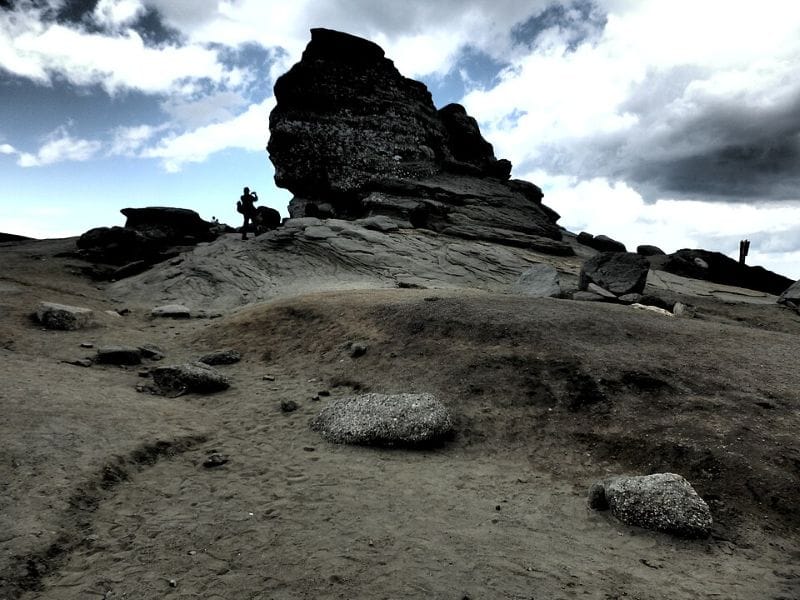
- Bucegi Sphinx — the nearby profile-shaped natural rock formation.
- Caraiman Cross — a separate high-mountain objective that requires additional route planning.
- Babele & Sphinx hike — the practical route page for the two formations.
- Bucegi Mountains — broader geography, access and mountain context.
- Hiking in Prahova Valley — compare mountain days before choosing a route.
Frequently asked questions about Babele
What are Babele in Romania?
Babele are a group of naturally eroded conglomerate rock formations on the Bucegi Plateau in Romania. Their rounded shapes are often compared with giant mushrooms or hunched human figures.
What does the name Babele mean?
The Romanian word babele means “the old women”. The name is commonly linked to the way some of the rounded rocks resemble old women when viewed from certain angles.
Are Babele natural or man-made?
They are natural rock formations. Bucegi Natural Park describes Babele as conglomerate rocks shaped by erosion. Claims that they were built or carved by an ancient civilisation are not established scientific explanations.
Where are Babele?
They are on the high Bucegi Plateau inside Bucegi Natural Park, close to the Bucegi Sphinx and the Babele mountain area.
How do I get to Babele from Bușteni?
The main choices are the Bușteni–Babele cable car when it is operating or marked mountain routes from the valley. For a first visit, use the cable-car guide and Babele & Sphinx route guide.
Are Babele close to the Bucegi Sphinx?
Yes. The two formations are in the same plateau area and are normally combined in one visit. See the Bucegi Sphinx guide for the second landmark.
Do I need a ticket to see Babele?
There is no separate attraction ticket just for the rock formations. However, Bucegi Natural Park currently lists a 10 RON adult visitor ticket valid for 3 months, and access may also involve separate cable-car, parking or transport costs.
Can I visit Babele in winter?
High-mountain access in winter depends on current weather, snow, wind, visibility, lift operation and route closures. Salvamont Prahova lists several routes around Babele and Caraiman as closed or restricted in winter, so check current warnings before attempting a visit.
Can I continue from Babele to Caraiman Cross?
Yes in suitable conditions, but it is a separate high-mountain objective, not part of a casual Babele photo stop. Use the Caraiman Cross guide and check current route conditions first.
What should I check before going?
Mountain weather, wind, visibility, the selected route, cable-car operation if relevant, daylight, footwear, clothing and current Salvamont warnings.
Understand the landmark first, then choose the route
Babele themselves are a compact natural attraction. The important planning decision is how you reach the high plateau and what else you add once you are there.
Official sources: Bucegi Natural Park, Bucegi Natural Park trails, Salvamont Prahova trail status, Salvamont Prahova warnings and Romania’s national weather service.