
Bucegi Sphinx, Romania: what it is and how to visit
The Bucegi Sphinx is one of Romania’s best-known natural landmarks, a naturally eroded rock formation on the Bucegi Plateau at around 2,200 m. Most visitors reach it through the Babele area, usually from Bușteni by cable car or on marked mountain routes. This guide explains what the Sphinx is, where it is and what to know before visiting.
Planning both famous formations? See our Babele & Sphinx hike guide.
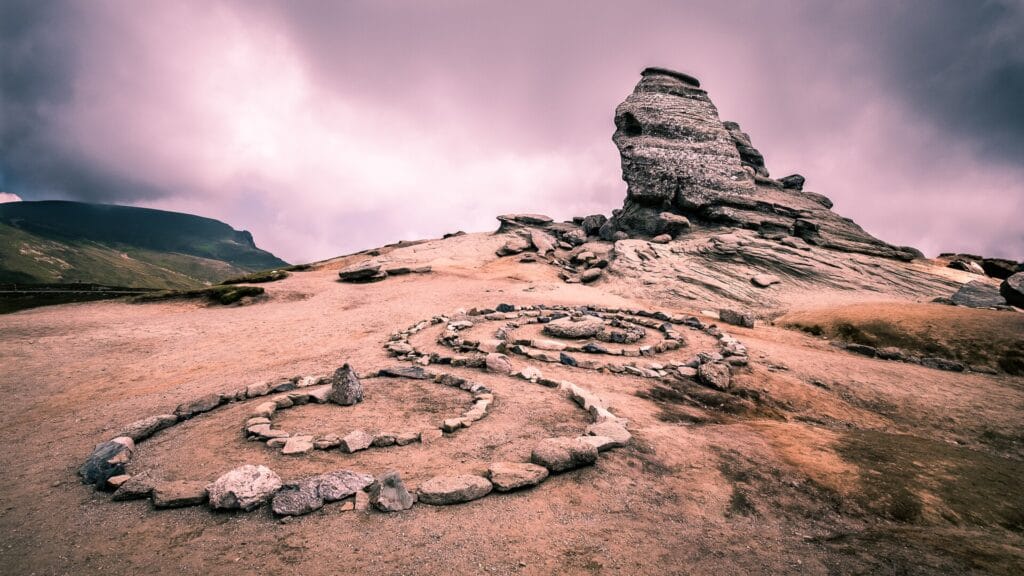
The face-like profile is angle-dependent; from other directions the Sphinx looks like a large weathered rock on the plateau.
What are you actually trying to plan?
This page is about the natural landmark. Access, cable-car operation and hiking routes have separate English guides so practical information can be updated independently.
Bucegi Sphinx
Stay here for geology, location, the face-like profile and what is fact versus folklore.
You are hereBabele & Sphinx hike
Use the route page for walking options, timing, preparation and how the two landmarks fit together.
Open the hike guide →Babele
The nearby mushroom-shaped rock formations have their own natural-landmark page.
Open the Babele guide →Bușteni–Babele cable car
Use the transport page for operation checks, weather limitations and the final walk on the plateau.
Open the cable-car guide →Scope of this page
Stay here if you want to understand the Bucegi Sphinx as a natural attraction.
This is not the main hiking guide, not a cable-car timetable and not a general Bucegi Mountains hub. For mountain context, use the Bucegi Mountains guide. For routes from the valley, use hiking trails from Bușteni.
What is the Bucegi Sphinx?
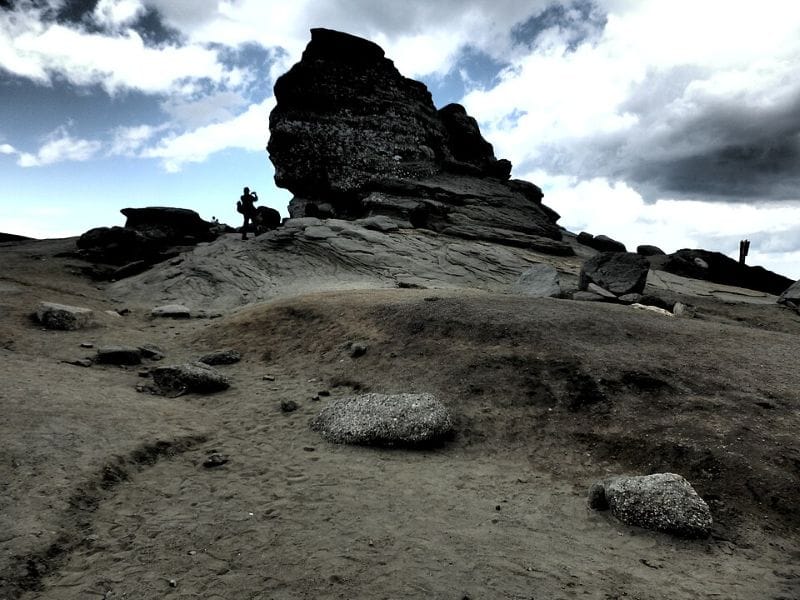
The Bucegi Sphinx is a large conglomerate rock whose outline can resemble a human head in profile when viewed from a particular direction. That resemblance is the reason for the name; it is not a sculpture or an archaeological monument.
Bucegi Natural Park describes the Sphinx and Babele as natural conglomerate formations created by long-term erosion. The park’s English-language material specifically identifies the Sphinx as the human-head-shaped formation and Babele as the nearby mushroom-shaped rocks.
Because the two attractions are close on the plateau, first-time visitors normally combine the Sphinx with Babele.
Useful facts before you go
The Sphinx is easy to underestimate because mechanical access can put you high on the plateau. You are still in an exposed mountain environment above 2,000 m.
As checked in August 2026, the park currently lists a 10 RON ticket for visitors aged 14+, valid for 90 days; children under 14 are free. There is no separate “Sphinx attraction ticket”, but the park fee is separate from cable-car, parking and other transport charges.
How did the Bucegi Sphinx form?
The evidence-based explanation is natural erosion of conglomerate rock on the exposed plateau.
The Sphinx is part of the conglomerate landscape that characterises much of the Bucegi Plateau. Bucegi Natural Park attributes the unusual rock shapes to erosion, especially the action of wind over very long periods.
Water, temperature changes and freeze–thaw cycles also weather exposed mountain rock. Different parts of the formation resist erosion at different rates, gradually producing the outline that people interpret as a face.
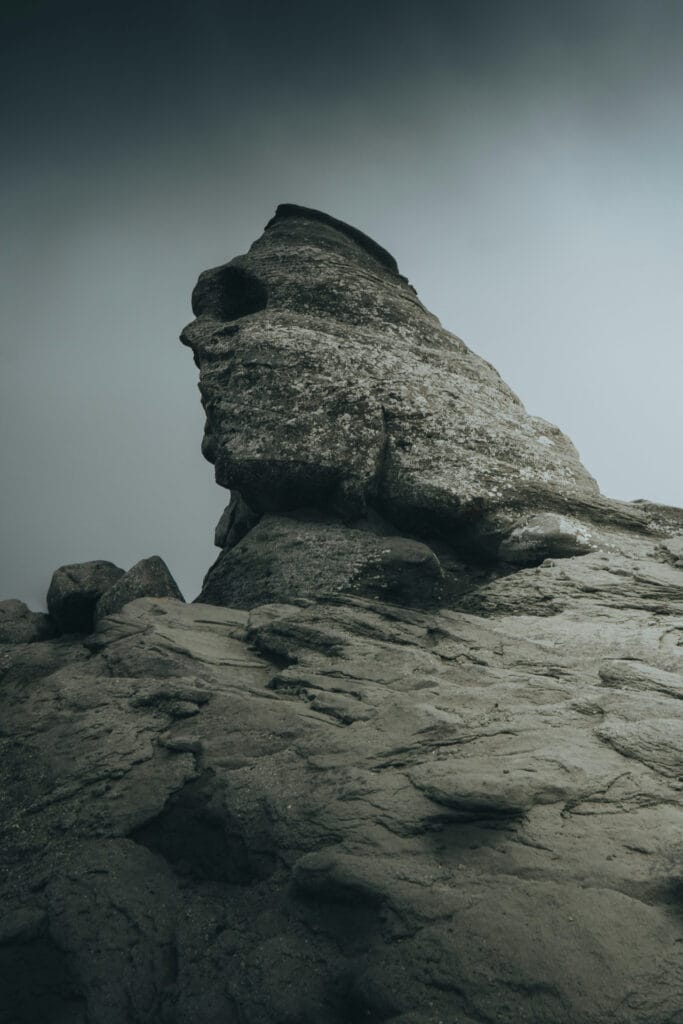
The key point for visitors is simple: the resemblance depends on viewpoint and light. From the classic side angle the profile is obvious; from elsewhere it can look like an ordinary weathered outcrop.
Why is it called a Sphinx, and what about the legends?
The rock’s appearance has attracted stories for decades, but folklore and modern mystical claims should not be presented as scientific explanations.
The name “Sphinx”
The name comes from the profile’s resemblance to a human head and its visual association with the Egyptian Sphinx. It is a descriptive comparison, not evidence of a historical connection.
28 November sunset stories
Romanian tourist folklore includes claims about a special light effect around 28 November. Treat this as popular tradition; it is not an established geological or astronomical property of the rock.
Dacian and “energy” theories
Stories about artificial construction, Dacian sanctuaries, tunnels or measurable “energy fields” are not supported as scientific explanations for the formation.
The legends are part of the Sphinx’s cultural afterlife, but the park’s geological explanation remains natural erosion of conglomerate rock.
How to get to the Bucegi Sphinx
The final approach is normally made through the Babele area. What changes dramatically is how you reach the plateau in the first place.
From Bușteni by cable car
The Bușteni–Babele cable car is the simplest mechanical approach when it is operating. Wind, maintenance, queues and weather can still alter the day.
From Piatra Arsă
Bucegi Natural Park currently lists the Piatra Arsă–Babele themed trail at 7.57 km, about 2 hours and easy-to-average difficulty.
On foot from Bușteni
The valley routes are proper mountain hikes. The Jepii Mici approach is steep, demanding and subject to winter closure.
Bușteni has a railway station on the Bucharest–Brașov corridor, so a car-free trip is possible. See the Bușteni guide and Prahova Valley without a car before planning the final transfer.
Do not treat the Sphinx as a city sightseeing stop
The Sphinx is on an exposed plateau above 2,000 m. Strong wind, fog, cold rain, snow and ice can make even a short walk difficult very quickly, while conditions in Bușteni may still look comfortable.
Check mountain weather, visibility, trail status, cable-car operation, daylight and your return plan before leaving the valley.
Salvamont Prahova currently lists the Bușteni–Jepii Mici–Caraiman–Babele route as closed in winter on the Bușteni–Caraiman section. It also lists seasonal closures or restrictions on several routes around Babele, Caraiman and the higher plateau. Always check the current status before choosing a winter approach.
What else can you see near the Bucegi Sphinx?
Babele is the natural companion stop. Caraiman Cross requires more time, suitable weather and its own route decision.

- Babele — the nearby mushroom-shaped natural formations.
- Caraiman Cross — a separate high-mountain objective that needs additional route planning.
- Babele & Sphinx hike — the practical route guide for both formations.
- Bucegi Mountains — broader geography, access and protected-area context.
- Hiking in Prahova Valley — compare mountain days before choosing a route.
Frequently asked questions about the Bucegi Sphinx
What is the Bucegi Sphinx?
It is a naturally eroded conglomerate rock on Romania’s Bucegi Plateau. From a particular angle its outline resembles a human head in profile.
Is the Bucegi Sphinx natural or man-made?
Natural. Bucegi Natural Park describes the Sphinx as one of the park’s conglomerate rock formations created by erosion. Claims that it was carved by an ancient civilisation are not established scientific explanations.
Where is the Bucegi Sphinx?
It is on the high Bucegi Plateau inside Bucegi Natural Park, close to Babele and normally approached through the Babele area.
How high is the Bucegi Sphinx?
The formation is generally described as being at roughly 2,200 m elevation. The important planning point is that the entire area is exposed high-mountain terrain above 2,000 m.
How do I get to the Sphinx from Bușteni?
The main choices are the Bușteni–Babele cable car when it is operating or marked mountain routes from the valley. Use the cable-car guide and Babele & Sphinx route guide before travel.
Is the Sphinx close to Babele?
Yes. The two landmarks are in the same plateau area and are normally combined in one outing. See the Babele guide for the second attraction.
Do I need a ticket to see the Bucegi Sphinx?
There is no separate attraction ticket just for the rock. Bucegi Natural Park currently lists a 10 RON visitor ticket for ages 14+, valid for 90 days; cable-car, parking and other transport costs are separate.
Can I visit the Bucegi Sphinx in winter?
Only after checking current weather, snow, wind, visibility, lift operation and route status. Salvamont Prahova lists several routes around Babele and Caraiman as closed or restricted in winter.
Can I continue from the Sphinx to Caraiman Cross?
In suitable conditions, yes, but Caraiman Cross is a separate high-mountain objective rather than part of a casual Sphinx stop. Use the Caraiman Cross guide and check route conditions first.
Are the stories about Dacians, tunnels or energy fields true?
They are part of modern folklore and speculative interpretations. They are not established scientific explanations for the rock. The evidence-based explanation is natural erosion.
See the Sphinx, but plan the mountain first
The landmark itself is a short stop once you are on the plateau. The real planning decision is how you get there, what the weather is doing and whether Babele or Caraiman belongs in the same day.
Official sources: Bucegi Natural Park, Bucegi Natural Park trails, park ticket information, Salvamont Prahova trail status, Salvamont Prahova warnings and Romania’s national weather service.